Erosion of tacit knowledge transfer
Career opportunity cost — the hidden cost of a career decision — is difficult to measure and easy to underestimate, until it compounds into something that shows up as a misread of company culture or complex stakeholder dynamic, a failed leadership transition, an unexpected departure, or a stalled promotion.
This cost is heightened by the quiet erosion of access to tacit knowledge transfer (also known as “informal” knowledge transfer).
The overheard conversation between senior leaders after a difficult board meeting, or the lunch with an executive navigating a current reorg or acquisition. These moments of observing complex decisions being weighed in real time emerged organically, reflecting the inherently information-based nature of most of our work. However, increasing retirements, greater workforce mobility, more geographically dispersed teams driven by remote and hybrid work, and reduced staffing as a result of digitalization and AI adoption (resulting in leaner teams and increased responsibilities) have collectively limited opportunities for these informal knowledge exchanges. The collective impact of these changes is eroding the primary mechanisms through which tacit knowledge (the “know-how”, pattern recognition, business acumen, and insights) transferred from executives to future industry leaders.
The erosion of these organic pathways has created a need to intentionally create knowledge transfer infrastructure.
Retiring executives, leaners teams, hybrid/remote work, digitalization and automation are eroding previous networks and pathways that enabled informal knowledge transfer.
What does the research reveal about this network erosion?
The most rigorous evidence of this erosion comes from a large-scale causal study published in the ‘Nature Human Behaviour’, drawing on Microsoft’s firm-wide shift to remote work. The findings were specific and significant: remote work made collaboration networks more static and siloed, with fewer bridges across groups and a measurable reduction in synchronous communication.¹ These are precisely the conditions that slow the spread of tacit knowledge, which, as Nonaka’s foundational research established, requires shared context, observation, and lived practice to transfer effectively.²
The implication isn’t that remote and hybrid work is all negative. The same research and adjacent studies consistently show stable or improved individual productivity for many knowledge workers in remote settings.³ That said, the cross-group connectivity to other employees and colleague weakened.
A study in the ‘Journal of Computer-Mediated Communication’ (JCMC) adds a layer to this. In hybrid settings, advice-seeking connections can decay when colleagues default to different communication tools. For example: one person defaulting to Slack, another to email, and another to brief video calls. The result isn’t dramatic, it’s gradual. Information flow doesn’t stop, but it quietly reduces and ultimately becomes inaccessible or requires significant effort to obtain.⁴ Statistics Canada data shows that roughly one in five Canadian employees worked most of their hours from home by late 2023, with hybrid arrangements having gained permanent ground.⁵
These aren’t temporary adjustments. It’s the new environment within which mid-career professionals find themselves operating in. It’s increasingly isolating and the mounting uncertainty of today’s macroeconomic landscape has increased decision risk, making access to experienced perspectives, sharp insights, and proven “know-how” more critical than ever.
We are recreating the flow of “know-how”. careerNPV’s knowledge capital infrastructure provides the mechanisms to improve knowledge capital transfer.
Effects of narrowing access to networks
The research points to three compounding effects
Slower pattern recognition on leadership dynamics
Much of what a mid-career professional needs to develop as a leader, including how executive decisions actually get made, what stakeholder navigation looks like at the level above them, and how organizational politics operate beneath the surface, are mainly acquired through “apprenticeship”. This includes being in the room and experiencing how senior leader handle complex situations in real time. Hybrid and remote environments reduce the frequency of these interactions, and they are not being actively replaced.
The reduction in cross-group bridge
In-person environments allowed for connectivity with colleagues from different departments and sidebar conversations that would never otherwise happen. These moments, while unplanned, were key mechanisms for creating connectivity across organizational silos and expanded your network beyond immediate colleagues. These also increased the surface area of opportunity to access insights and “know-how’s” on organizational dynamics and other matters.
The extended timeline of new role transitions
Onboarding and leadership transitions stretch longer and are more challenging because informal transition support previously shared through physical proximity, whether it was a hallway check-in or a coffee with a senior peer, now requires more proactive and deliberate action in hybrid and remote settings. Leaders complain that transitions are challenging, frustrating and lonely.
Recreating networks in practice
The following is a composite profile reflecting how leaders are adjusting to modern workplace disruptions
Sophie inherited a geographically distributed team with simmering tensions that predated her arrival at the new company. She had strong foundational leadership instincts and a sense of how she wanted to operate, but the informal network that would ordinarily help a new leader read the room quickly didn’t exist for her in the same way it might have in a fully physical environment.
In her first ninety days, she made two deliberate moves. She created and shared a lightweight operating manual with her team. It included decision rights, escalation paths, and how she intended to work. She also instituted virtual monthly sessions she called ‘shadow the decision’, where team members could observe and ask questions on how she weighed trade-offs on leadership decisions.
These weren’t complicated interventions. They were intentional mechanisms designed to recreate what proximity once allowed for organically. They improved visibility into how decisions actually get made. Her demonstration of vulnerability by showing how she made decisions, improved her connection with her team and their overall psychological safety.
When a situation with a long-tenured employee. who has strong executive sponsorship, escalated unexpectedly in ways she hadn’t navigated before, her big problem was:
“Who can I ask for help?”
It was a high-stakes situation, so she was uncertain of her approach and the potential outcome. She was capable of handling the situation but consulting someone who had dealt with this before would give her clarity and confidence to control the outcome.
She was new to the company, so she sought guidance from an executive at her past employer, who had already handled a comparable dynamic. It was her best alternative to “trial and error”. The result was faster resolution, greater confidence in her approach, and considerably less political fallout than if she had mishandled the situation.
Four mechanisms for knowledge transfer activation!
Rebuilding the tacit knowledge pathways that AI enabled workplaces, remote work and hybrid environments have narrowed isn’t a single intervention. It’s a set of deliberate practices that compound to replace the knowledge transfer pathways that physical proximity previously provided.
Four mechanisms are worth activating:
Audit your advice network and align on medium.
- Identify the people whose knowledge genuinely informs your professional judgment. Then check: are you actually in consistent contact, and on a medium that works for both of you? Research suggests that advice-seeking connections quietly erode when there’s no alignment on communication tools. A quarterly audit of “who are my five most valuable informal advisors, and “are we actually in regular contacts” keeps this network activated.
Institute Decision Rituals.
- These are purpose-built moments which regenerate the cross-group bridges that remote and hybrid environments reduce. These moments include cross-functional office hours, rotating peer feedback on high-stakes decisions, and making key meetings ‘remote-first’ by default so informal access is equitable regardless of location.
Shadow the decision.
- Invite key contributors to observe how you weigh trade-offs for key decisions, then debrief in a ten-minute recorded session afterward. This converts your tacit decision-making process into something others can observe and learn from. It demonstrates acceptable risk-taking, builds trust, increases psychological safety and accelerates team cohesion in distributed team environments.
Expert guidance for high-stakes decisions.
- The research on executive coaching and “crisis averting” expert guidance consistently points to the highest returns at moments of specific, high-stakes navigation, including taking on a new P&L, a challenging senior stakeholder relationship, or a significant career transition.⁶ Generic advice is widely available and hybrid/remote environments have made it harder to find “crisis averting” situational navigation from executives who have solved similar problems you’re dealing with. Access to these individuals is not widely available and requires deliberately undertaking.
What this piece covers — and where to go next
This piece has focused on a specific territory: how hybrid/remote and AI-enabled work environments have narrowed the informal pathways through which tacit knowledge transfers, and the mechanisms that recreate transfer and access.
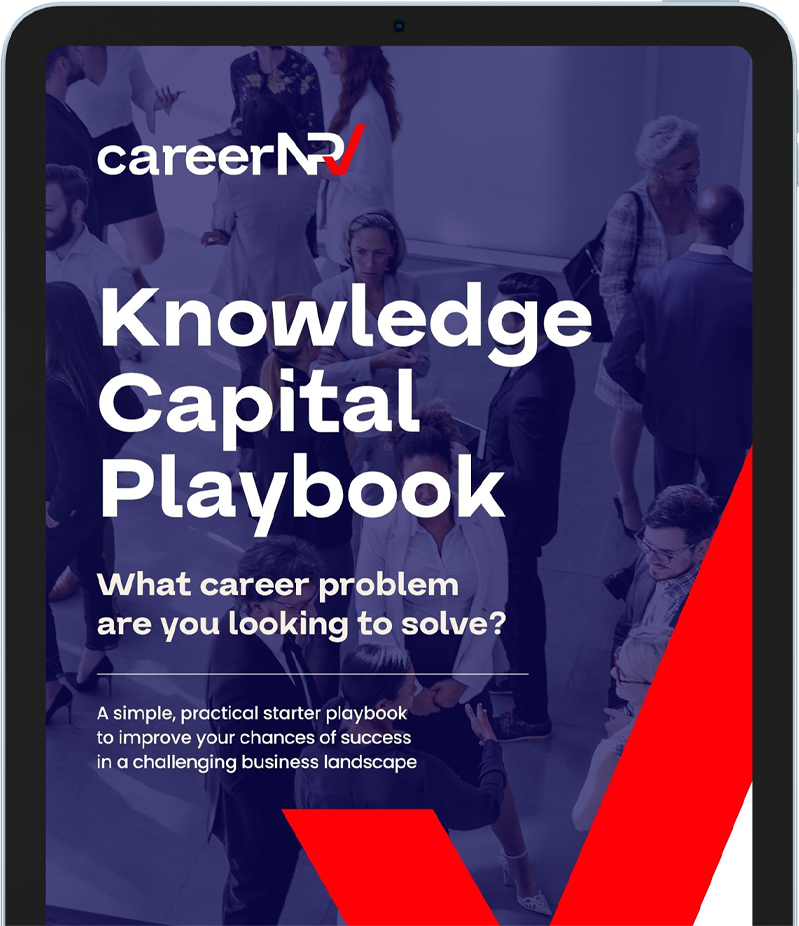
‘The Career Edge That Compounds,’ establishes what knowledge capital is and why access to it is the competitive advantage. ‘The Knowledge Capital Playbook,’ translates these mechanisms into a practical, immediate starting point for mid-career professionals.
Sign up to careerNPV and get the complimentary Knowledge Capital Playbook
Sources
¹ Nature Human Behaviour — “The Effects of Remote Work on Collaboration Among Information Workers.“
² Frontiers in Psychology — “Managing Knowledge in Organizations: A Nonaka’s SECI Model Operationalization.“
ASCN Higher Education — “SECI Model of Knowledge Creation.“
³ Harvard Business Review — “Making the Hybrid Workplace Fair.“
⁴ Journal of Computer-Mediated Communication — “Information Sharing in a Hybrid Workplace.“
⁵ Statistics Canada — “Working from Home in Canada.“
⁶ International Coaching Federation — “Coaching Statistics: The ROI of Coaching in 2024.“
Forbes Coaches Council — “The ROI of Executive Coaching: A Comprehensive Guide.“