
Most professionals are navigating careers on their instinct alone
There’s a particular moment when most mid-career professionals recognize that they’re on their own. It’s usually when they are facing a career situation that carries real stakes — a surprise exit, a difficult influential stakeholder relationship in need of careful handling, a reorg that changes the landscape under their feet, or a role transition that’s more than they bargained for. These can be lonely moments, full of uncertainty and doubt and most leaders act on instinct. This has led to 40-60% of first-time leaders failing or underperforming in their first 18-24 months.¹ These stats are likely to increase as organizational landscapes become increasingly more complex and with leadership decision risk higher than ever.
Leadership is harder now than it’s ever been. In 2025, a record number of CEOs (2,221) in the US exited their roles, on the heels of an all-time high set in 2024 (1914).²
So how valuable is it for leaders to have direct access to senior executives who’ve navigated a similar terrain or similar complex leadership issues before? Is it worth $100,000, $250,000 or millions of dollars? It really depends on what’s at risk, but the leaders that we’ve surveyed say it’s invaluable.
The mid-career professionals who navigate successfully are the ones who have invested the time to build relationships and establish systems to access the right insights from the right source in their time of need.
careerNPV was founded to help you establish these systems and relationships so that you can readily get help to solve complex, high-stakes career problems with clarity and confidence.
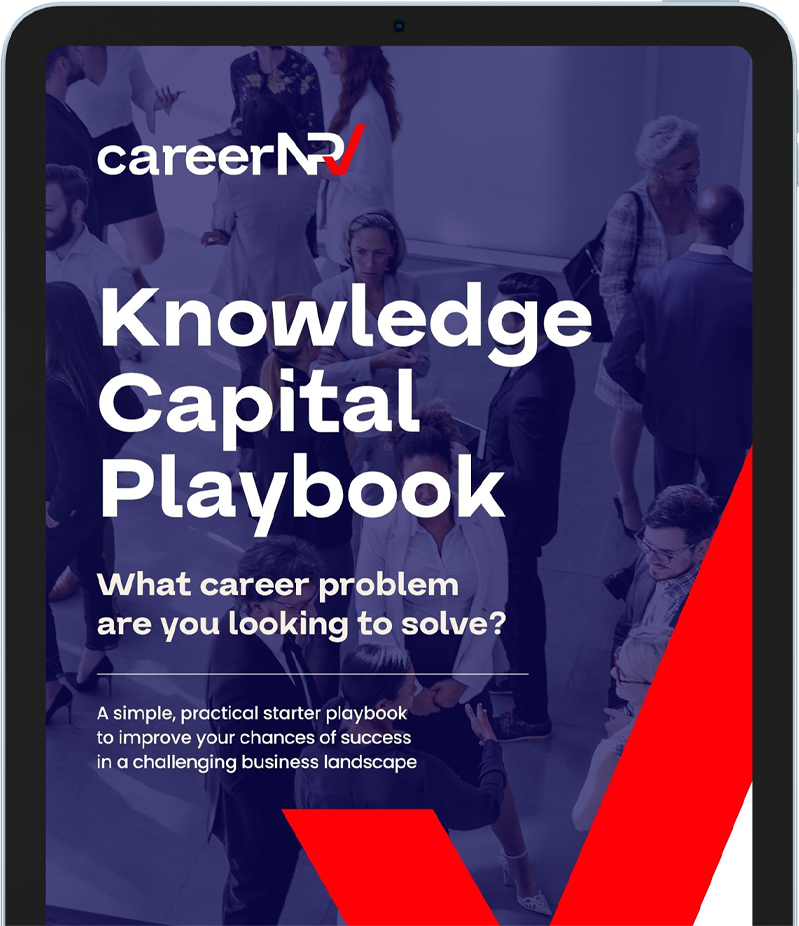
Our 4-Week Knowledge Capital Playbook is a practical starting point to help you build systems and relationships that improve your leadership judgment. This article walks through what the playbook is designed to accomplish and why it matters. The tools, templates, trackers, and session frameworks to support your progress are all available in the full playbook.
Sign up to careerNPV and get the complimentary Knowledge Capital Playbook
What this playbook is built to accomplish
The design logic of the Knowledge Capital Playbook is worth dissecting because the framework isn’t structured arbitrarily.
The playbook covers various knowledge capital pathways to target. Week 1 surfaces the tacit knowledge you already have. Week 2 expands the network through which you access new insights and “know-how”. Week 3 recreates the informal transfer mechanisms that hybrid, remote and AI-enabled environments have narrowed. Week 4 outlines how to frame your expert insight sessions to get the best support from executives.
Each week builds on the one before it. Behaviour change sticks best through small, frequent practice. Therefore, threaded through all four weeks is a brief 15-minute, daily micro-habit practice session where you reflect on a small win or improvement and a weak-connection nudge. This daily habit keeps the learning flywheel turning between the weekly structured activities.
WEEK 1
Your Narrative
Goal: Increase clarity about how you create value and how you make decisions.
Most mid-career professionals have a general sense of where they add value. Fewer articulate their value well enough, whether it’s within an interview setting, key stakeholder conversations, or board presentations.
Week 1 closes that gap through two tools:
Decision Log
The first is a Decision Log — a structured record of a few key decisions you’ve made recently, the context you were operating in, the options you considered, and what the outcomes revealed. Most professionals have made hundreds of significant decisions over their careers but very few document the patterns those decisions reveal, including how they think, where they thrive, and what their blind spots are. Documentation of tacit knowledge converts your personal “know-how” into knowledge that is easily surfaced, portable, deployable, and can be shared.
Leadership Thesis
The second is your Leadership Thesis: a two-to-five sentence statement that answers the questions of i) Where do you create disproportionate value? ii) In what contexts do you operate best?” and iii) What are your differentiators, and what proof points support them? A great Leadership Thesis communicates your value within thirty seconds.
The thoughts that tend to surface here are:
“I’ve never put this into words before.”
“I don’t know where to start.”
That’s the exactly what the Knowledge Capital Playbook is designed to help with. It gives you the structure to start if you haven’t done this exercise before.
Week 1 is good preparation for your network activation, stakeholder conversations, and expert sessions. This becomes the narrative anchor that makes each week of the playbook more effective.
WEEK 2
Network Activation
Goal: Expand your surface area of opportunity.
A large-scale causal study found that the connections most likely to open doors to new opportunities are not the close colleagues you interact with daily. It’s your second-degree connections: the executives and leaders in adjacent roles and sectors who bring non-overlapping information into your orbit.³
Most mid-career professionals tend to be inwardly focused resulting in the quiet narrowing of their network over time. Their network becomes deeper within a small circle and shallower everywhere else.
Week 2 is designed to systematically widen your network surface area. The goal is to identify second-degree leaders and executives in adjacent roles and sectors (those you have never connected with or those you haven’t connected with recently). Challenge yourself to reach out to an number of them, sending tailored outreach messages. Your goal is to schedule a handful of conversations.
The thought that tends to surface here:
“I’m not good at reaching out to people I don’t know well.”
First identify what you can offer to the relationship. You are not networking for networking’s sake. A value forward proposition is needed in your outreach. You want to be purposeful and deliberate. Your goal is to balance between contributing insights to the business relationship and gaining insights to current or future problems you’re encountering.
The Knowledge Capital Playbook provides a guide on how to approach this.
WEEK 3
Knowledge Transfer Bridgework
Goal: Restore the informal knowledge flow that AI-enabled workplaces and hybrid/remote work have reduced.
As explored in ‘Hidden Cost on Leadership’, large-scale research confirms that hybrid, remote and AI-enabled environments have made collaboration networks more static and siloed, with fewer cross-group bridges and less of the ambient interaction through which tacit leadership knowledge spreads.⁴
Week 3 is designed to recreate those bridges intentionally.
Feedback session
The first is a Group Feedback session (25 mins) — a short, structured session where a leader or team member shares work in progress with peers or contributors. This exposes the decision logic and invites input before a final call is made. This isn’t a presentation of a polished outcome. It’s the opposite. It’s a deliberate exposure of the trade-offs being weighed, the risks being navigated, and the questions still open. You get insights that eliminate blind spots, while at the same time restoring network bridges.
Decision Rituals
The second is a set of Decision Rituals (10 mins) — lightweight, repeatable practices designed to recreate the informal cross-team interactions that physical proximity enabled organically. The Knowledge Capital Playbook includes four specific rituals with their cadences, ownership, and the specific knowledge transfer mechanisms that are activated.
The thought that tends to surface here:
“I’m too busy.”
Shed the activities that are holding you back and prioritize the ones that move you forward. Or else, the impact of these ill-prioritized items will catch up to you in the long run.
The Group Feedback and Decision rituals have high ROIs because they increase clarity, reduce decision friction, reduce decision risk, and improve judgment.
WEEK 4
Expert Insight
Goal: Avert crisis and derisk decisioning by leveraging an industry expert for complex problems.
The first three weeks of the Knowledge Capital Playbook build the foundation for week 4: a clearer narrative, a wider network, and restored feedback loops within your existing environment. Week 4 targets access to executives who have solved similar complex leadership problems that you’re facing.
This is not general coaching or long-term mentorship. It’s targeted and specific.
In Week 4, you’ll set up two sessions with an industry expert, each conversation anchored to one concrete problem that you’re navigating right now. This could be: i) how to deal with a new VP who doesn’t yet trust your insights, ii) to manage a board update with high political stakes or iii) how to manage competing expectations of two leaders who don’t see eye to eye. These challenges have high decision risk and uncertain outcomes.
Research on coaching and expert guidance consistently points to the highest returns when the scope is narrow and application is immediate.⁵ In Week 4, you are presenting fifteen minutes of context to an executive in your network who have navigated your complex problem many times and are leaving with steps to implement immediately.
The Knowledge Capital Playbook outlines an approach to prepare for this interaction. A simple, structured way to prepare ahead of the session to ensure that the interaction is significantly more effective.
The thought that tends to surface here:
“I don’t know how to find the right person to talk to, or what to say when I do.”
careerNPV was built to solve for this.
We have a strong network of experienced leaders and executives who have a strong interest in investing in the future generation of leaders by helping you solve your most pressing career problems.
What you measure at the end of four weeks
The playbook includes a measurement framework for reviewing outcomes at the end of the four-week period.
Five indicators to track:
- New opportunities surfaced through weak connections.
- Lessons and insights from key decisions captured in the Decision Log.
- Cycle time on one key workstream deliverable that you prioritized for Group Feedback.
- Number of knowledge transfer bridges completed.
- Sentiment (yours and adjacent stakeholders) of your problem statement and your approach before and after a targeted expert insight session.
This allows you to reflect on how the knowledge capital systems and relationships you’ve built are actually working for you and obtain foresight on what to focus on in the next cycle.
The Knowledge Capital Playbook: what’s inside
The full careerNPV Knowledge Capital Playbook contains six tools to support your 4-Week journey.
Tool 1: Decision Log Template
- A structured format for capturing three decisions, their context, options, chosen path, and outcomes, along with the insight each one surfaces about your leadership patterns.
Tool 2: Leadership Thesis Template
- Prompts and examples that guide you through articulating where you create disproportionate value.
Tool 3: Weak Connection Outreach Tracker
- A structured system for identifying second-degree contacts, tracking outreach, and moving conversations from initial contact to scheduled sessions.
Tool 4: Group Feedback — Mini Agenda and Script
- A complete session, including an example of how to frame your agenda points.
Tool 5: Decision Rituals Planner
- Four decision rituals with cadences and the knowledge transfer mechanisms that are activated.
Tool 6: Expert Insight Session Briefing
- A preparation guide that structures context and desired outcomes before each session.
Sign up to careerNPV and get the complimentary Knowledge Capital Playbook
Where to go deeper
This article introduces the 4-Week Knowledge Capital Playbook and the logic behind it.
Two companion pieces build the foundation upon which the playbook was created.
‘The Career Edge That Compounds’ establishes what tacit knowledge capital is and why access to it is the competitive advantage that separates professionals navigating complex markets.
‘The Hidden Cost of the Modern Workplace on Leadership Development’ examines the research behind what has changed in hybrid, remote and AI-enabled environments, creating the need for intentional access to tacit knowledge capital, especially leadership insights and “know how”.
Both these articles should be read alongside this piece.
Sources
¹ Gartner (formerly CEB) — “Leader and Manager Development.“
² Korn Ferry — “The Great CEO Exodus… Continues.“
³ MIT News — “The Power of Weak Ties in Gaining New Employment.“
Harvard Business School — “A Causal Test of the Strength of Weak Ties.“
⁴ Nature Human Behaviour — “The Effects of Remote Work on Collaboration Among Information Workers.“
⁵ International Coaching Federation — “Coaching Statistics: The ROI of Coaching in 2024.“
Forbes Coaches Council — “The ROI of Executive Coaching: A Comprehensive Guide.“